

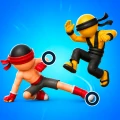
Draw Clash Hero
Iron Glitch
I approached Draw Clash Hero as the kind of action game someone might pick up during a spare moment and then hand to another person in the same household. Its central idea is easy to understand: you draw a movement or attack path, then watch that choice turn into a clash with enemies. That makes the game immediately more interesting than a standard action title built only around tapping buttons, because your input is about planning a gesture rather than simply reacting to one.
After spending time with it, my impression is that the appeal comes from the tension between a quick drawing action and the result that follows. A line can feel confident when you make it, but the real test is whether it places your hero in a useful position once enemies enter the scene. I like that the concept invites experimentation without requiring a long explanation. At the same time, it is not the right fit for someone looking for a deep role-playing system, a large social game, or a carefully structured family experience.
How the drawing-based combat feels in everyday play
The first thing I noticed is how different the game feels from a conventional action title. Instead of treating movement as a constant stream of directional controls, it asks me to think in short visual decisions. I look at the situation, decide where I want the hero to go or strike, and draw the move. That small pause before acting gives each encounter a puzzle-like edge, even though the overall category is still action.
This approach works especially well when I want something more engaging than a passive time filler. For example, I can imagine opening it while waiting for dinner to finish, playing a short sequence, and then putting the phone down without needing to remember a complicated story or a long list of objectives. The drawing mechanic gives those brief sessions a clear focus: observe, sketch a response, and see whether the decision holds up.
The trade-off is that the same simplicity can become limiting for players who want precise manual control at every instant. A traditional action game may let me adjust movement continuously, cancel an attack, or respond with several buttons in quick succession. Here, the drawn instruction is the important moment. If I prefer direct control over every step, I may find the interaction less satisfying than a standard twin-stick or button-based game.
Related News





I also think the control style makes the screen more personal when several people share one device. One person can draw a move, watch the outcome, and pass the phone to someone else for the next attempt. That does not turn the game into a confirmed multiplayer experience, and I would not treat it as one, but the visual nature of the mechanic makes informal turn-taking easy to understand. It is a better fit for casual cooperation around a sofa than for a serious competitive session.
What to watch during a clash
A useful habit is to stop drawing the first move that looks dramatic. I get more value from treating each gesture as a small tactical decision. Before acting, I consider whether the path leaves the hero exposed, whether it approaches the enemy from a useful angle, and whether the move creates a better position for what comes next. That extra moment is where the game becomes more than a simple line-drawing novelty.
Another practical tip is to use early encounters as a way to learn the game’s visual language rather than rushing to prove that every move can be aggressive. I pay attention to how the hero responds to different shapes and distances. If a line produces an awkward result, I adjust the next attempt instead of repeating the same gesture. This makes the learning process feel active, and it is also a good way for a second household member to understand the controls without a formal tutorial session.
Gallery
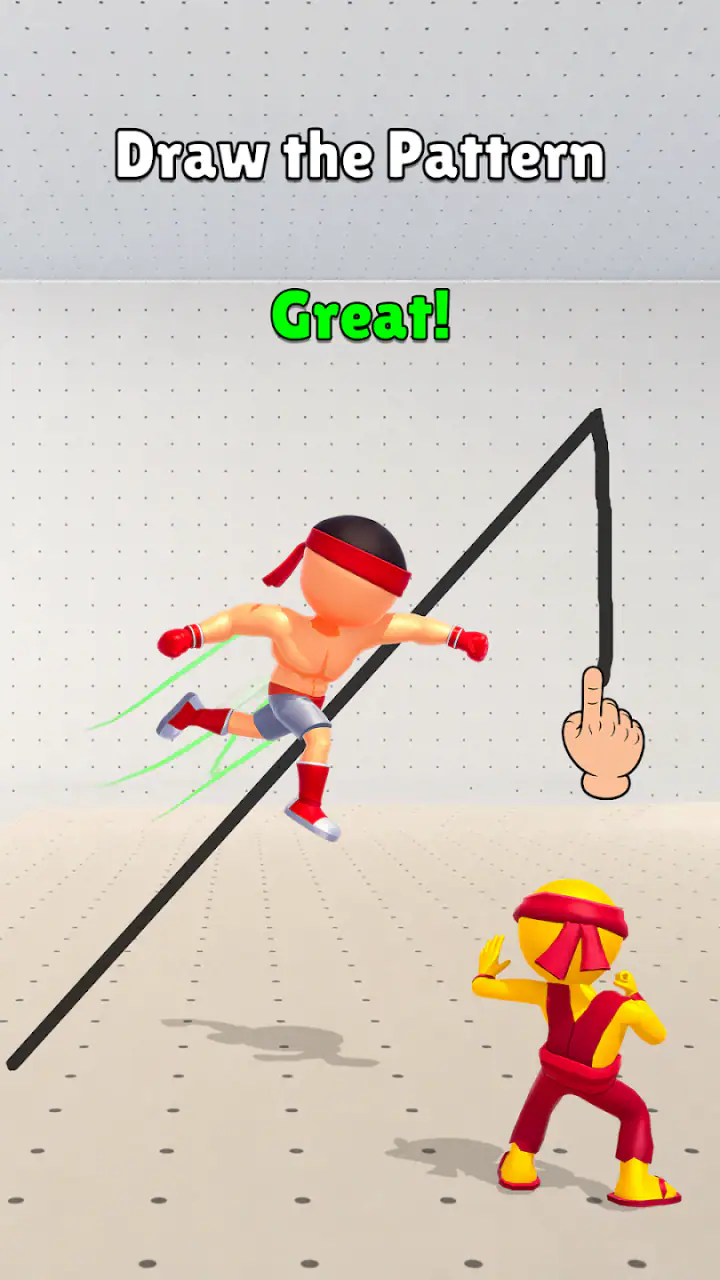
There is a subtle trade-off between a short, controlled drawing and a longer gesture that tries to do too much. A compact move is easier to read and repeat, while an ambitious path may look clever but become harder to judge. I prefer starting with simple shapes, especially when I am introducing the game to someone else. Once the basic relationship between the drawing and the hero’s action feels clear, experimentation becomes more rewarding.
Sharing one device without creating confusion
Draw Clash Hero works best in a shared-device setting when everyone agrees on what a session means before starting. Since the game is presented as a single action experience rather than a household management tool, I would not assume that it separates players automatically or preserves a distinct identity for each person. If several people use the same phone or tablet, the cleanest approach is to decide whose turn it is and avoid changing settings or progress casually.
That boundary matters more with younger users. A child may see the drawing mechanic and understand it quickly, but the person who owns the device should remain responsible for deciding whether the game belongs on that device and whether its content suits the household. The title carries a Mature 17+ content rating, so I would not treat its simple control scheme as evidence that it is intended for children. Ease of play and age suitability are separate questions.
For a family or shared apartment, I would also recommend a short handoff routine: finish the current encounter, stop at a natural point, and tell the next person what has changed. That avoids the common problem where someone picks up a game, makes an unexpected move, and leaves the original player unsure whether progress or strategy has been altered. It is a small habit, but it makes a shared phone feel less like contested property.
There is no need to invent a complicated household system around it. I would simply keep the game on the device of the person who is comfortable managing access, and I would avoid presenting it as a child-friendly group activity. For adults sharing a phone, the quick visual format is convenient. For a household with children, the age context should come first, even if the game looks approachable at a glance.
Setup, software fit, and practical expectations
The game is free to download, which lowers the barrier to trying its unusual control idea. That is useful when I am unsure whether drawing combat will suit me; I can test the basic feel without making a purchase decision first. Free access does not automatically make a game a good choice for everyone, though. I still consider whether the action loop fits my taste and whether the Mature 17+ rating is appropriate for the intended player.
Its listed minimum operating-system requirement is Android 7.1, so owners of compatible older Android devices may have a chance to run it without needing a recent phone. I would still keep expectations sensible on older hardware. A minimum requirement tells me about basic compatibility, not how comfortable the game will feel on every screen size or how smoothly every encounter will behave. Drawing is a visual input, so a cramped display can make gestures less pleasant even when the software installs successfully.
The current release is version 0.9, which shapes my expectations. I read that version number as a sign to approach the game with some patience rather than assuming it has the polish or breadth of a long-established action series. In practice, I would try it, notice how consistent the drawing response feels, and decide whether its core loop is already enjoyable enough for me. I would not choose it because I expect a huge amount of content based only on the version label.
The developer is Iron Glitch, and the game has reached more than half a million installs. Its average rating is 3.8 from roughly 537 ratings, a reception that suggests a mixed but meaningful level of interest rather than universal approval. I see that as a reason to judge the interaction personally. The concept is distinctive enough to attract attention, but the rating also reminds me that an inventive premise does not guarantee that every player will enjoy the execution.
Who should use it, and who should skip it
I would recommend giving it a chance if you enjoy experimenting with unusual controls, like action games that ask for a little planning, or want a compact title that can be demonstrated quickly to a friend. It is particularly suitable for someone who enjoys watching an idea play out after making a deliberate input. The pleasure is not only in winning; it is in seeing whether the line I imagined produces the result I expected.
I would skip it if my priority is a large campaign, a strong narrative, extensive character customization, or a clearly defined online community. Nothing about the core premise suggests that it is trying to replace a full-scale action role-playing game. Players who need precise, continuous control may also prefer a conventional action title, because drawing a move introduces a layer of interpretation between intention and execution.
The age rating is the most important reason I would not recommend it casually to children. A simple gesture system can make a game look harmless, but the Mature 17+ label should guide the decision. In a household with teenagers or younger children, I would keep the game for adults unless the responsible adult has personally reviewed its suitability. I would also avoid letting a child use the owner’s device unsupervised simply because the game is free and easy to start.
For older relatives or guests who rarely play games, the drawing idea could be more approachable than a dense control layout, but I would introduce it in a quiet setting. The person needs time to see what the gesture does and understand the result. Handing over the device during a noisy group gathering may create frustration, especially if several people are giving different advice about where to draw.
How it compares with ordinary action alternatives
Compared with a button-driven action game, this one places more emphasis on anticipation. In a conventional title, I might rely on reflexes, memorized combos, or a familiar movement stick. Here, the drawn path is the main conversation between me and the game. That makes it stand out, but it also means the experience depends heavily on whether I enjoy thinking visually and accepting the game’s interpretation of my gesture.
Compared with a puzzle game, it has more immediate physical energy. I am not just arranging pieces or searching for a single correct answer; I am trying to make a hero survive a confrontation. Yet it does not offer the same broad strategic space as a complex puzzle game. The interesting decisions are concentrated around movement and clashes, so anyone seeking resource management or long-term planning may find a traditional strategy title more rewarding.
Compared with a social party game, it is easier to understand in a one-person session but less obviously designed around a group. I can pass the device around and discuss possible moves, but I would treat that as an informal way of sharing the experience, not as a substitute for confirmed multiplayer features. For a household wanting a game built specifically around several players, a dedicated local multiplayer option would be the safer choice.
The key comparison, in my view, is not whether it has more content than larger alternatives. It is whether its drawing mechanic gives me a kind of involvement I do not get from tapping an attack button. When the gesture feels readable and the outcome feels connected to my decision, it has a clear identity. When I want a richer system, more control, or a longer progression path, another action game will probably serve me better.
Small habits that improve the experience
I get the best results when I treat the screen as a planning space rather than scribbling quickly. I make the intended direction clear, keep the gesture purposeful, and watch the result before deciding what to change. This is especially helpful when introducing the game to another adult, because it turns the first session into a shared experiment instead of a test that someone can fail immediately.
I also recommend separating experimentation from serious attempts. During a relaxed session, I try different shapes and observe how the hero behaves. When I want a cleaner run, I return to movements I already understand. That distinction prevents me from blaming the game for an outcome caused by an intentionally uncertain gesture, and it gives me a simple way to explain the controls to a new player.
On a shared device, I would avoid making a major attempt while someone else is waiting impatiently for a turn. The game’s appeal depends on attention: a player needs to see the enemies, draw carefully, and interpret the result. A short agreed turn is more enjoyable than a rushed handoff. If the phone belongs to someone else, I would also ask before changing anything, since the game does not become a separate personal space merely because several people enjoy it.
For adults who are sensitive to action-game content, the Mature 17+ rating deserves a deliberate check before installing. The free price makes testing easy, but it does not remove the responsibility to match the game with the person using it. That is particularly important when the device is shared with children, guests, or anyone who may assume that a simple control scheme means the content is suitable for all ages.
My household verdict
My overall view is cautiously positive. Draw Clash Hero has a focused idea that gives ordinary action encounters a different rhythm: I draw, commit, and judge the result. That is enough to make it worth trying for adults who enjoy inventive controls and short sessions. The free entry point helps, and the broad install reach shows that the concept has attracted a sizeable audience, while the 3.8 average tells me to keep my expectations balanced.
I would place it on an adult’s personal device or on a shared household device with clear boundaries. I would not present it as a children’s game, a guaranteed multiplayer experience, or a replacement for a deep action adventure. Its strongest use case is a quick, visually understandable challenge that can be played alone or discussed informally with another person nearby.
The best reason to try it is the drawing mechanic itself, not a promise of endless depth. If that interaction feels satisfying after a few sessions, the game has done enough to earn a place in my rotation. If I find myself wishing for constant manual control, separate player accounts, a longer story, or more substantial progression, I would move on to a more traditional alternative without feeling that I had missed the point.
For me, the final decision is simple: adults who want an unusual action experiment should give it a fair test, while households should take the age rating and shared-device boundaries seriously. Iron Glitch has built the experience around a memorable input idea, and that idea is both its main strength and its clearest limitation. It makes the game easy to show, easy to start, and distinctive enough to remember, but whether it becomes a lasting favorite depends on how much I enjoy planning each drawn clash.
FAQs for Draw Clash Hero
What is Draw Clash Hero and how does the gameplay work?
Draw Clash Hero is a casual action game built around drawing your character’s equipment and then using it in battles. Before each encounter, you create or adjust weapons, shields, or other combat tools by drawing shapes on the screen. The game then turns your design into part of the hero’s fighting style. Matches are generally quick, making it suitable for short play sessions, although success depends on both your drawing choices and how effectively you handle each fight.
Is Draw Clash Hero free to download and play?
Draw Clash Hero can generally be downloaded without an upfront purchase, but the free version may include advertising, optional in-app purchases, or both. These purchases can sometimes provide extra resources, cosmetic items, or convenience features, depending on the current version. You should check the payment details on the Google Play Store or Apple App Store before downloading, especially if the game will be used by children or on a shared family device.
Does Draw Clash Hero require an internet connection?
Some parts of Draw Clash Hero may work without a constant internet connection, particularly basic gameplay or previously loaded levels. However, an online connection may still be needed for advertisements, cloud-related features, updates, rankings, special events, or in-app purchases. Offline availability can also vary between Android and iOS versions. If you plan to play while traveling, test the game in airplane mode first rather than assuming every feature will remain accessible.
Is Draw Clash Hero suitable for children?
Draw Clash Hero is usually easy to understand because its controls focus on drawing and simple action mechanics, which can make it appealing to younger players. Nevertheless, parents should review the game’s age rating, advertisements, privacy information, and in-app purchase settings before allowing regular play. Fast battles or repeated challenges may also encourage extended sessions, so parental controls and screen-time limits are recommended for younger users.
What should I know about performance, controls, and progression before downloading?
The game’s drawing controls are designed to be simple, but the accuracy and usefulness of your designs can affect the outcome of battles. Performance may differ depending on your phone or tablet, particularly on older devices with limited memory. Progression commonly involves completing fights, unlocking improvements, and experimenting with different designs. Keep enough storage available for updates, and remember that reinstalling or changing devices may affect saved progress if cloud backup is not supported.
Pros
- Simple controls make it easy for beginners to start playing.
- Quick battles are well suited to short gaming sessions.
- Drawing mechanics add a creative twist to standard fighting gameplay.
- Unlockable heroes provide variety as you continue progressing.
- Bright visuals and cartoon-style effects make fights entertaining.
Cons
- Gameplay can become repetitive after extended play.
- Some upgrades may require considerable time or repeated battles.
- Difficulty may feel uneven as stronger opponents appear.
- The drawing system can be imprecise on smaller phone screens.
- Ads may interrupt the experience
- depending on the version.


